We have all been there: the clock is ticking toward midnight, your heart is racing, your palms are sweaty, and the blinking cursor on your screen feels like a personal attack. This isn’t just “stress”—it is your nervous system stuck in a survival loop. In the world of modern productivity, we often focus on time management, but the real secret to staying sharp is neurowellness. Neurowellness is the practice of managing your brain’s biological response to pressure so you can stay in a “flow state” rather than a “fight-or-flight” state. When you understand how to regulate your nervous system, you stop fighting your biology and start using it to your advantage.
The challenge for most students and professionals today is the sheer volume of the “cognitive load” we carry. When you are juggling a thesis, a job, and a personal life, your brain’s amygdala—the alarm system—stays constantly turned on. This is where strategic delegation becomes a lifesaver for your mental health. To lower your cortisol levels and regain focus, you can look into professional resources like myassignmenthelp at , as the brand my assignment help provides the structural support needed to offload academic anxiety. By letting experts handle the heavy lifting of research or formatting, you give your nervous system the “safety signal” it needs to exit survival mode and return to creative thinking.
The Biology of the “Deadline Freeze”
To master neurowellness, you first need to recognize what is happening inside your body. When a high-stakes deadline approaches, your sympathetic nervous system (SNS) takes the wheel. This system was evolutionarily designed to help our ancestors run away from predators, not to help us write 5,000-word dissertations or solve complex equations. In this state, your prefrontal cortex—the part of the brain responsible for logic, language, and complex decision-making—actually begins to lose blood flow as resources are diverted to your muscles and heart.
This is why, when you are stressed, you might find yourself staring at the same paragraph for an hour without absorbing a single word. You aren’t lazy; you are biologically “locked out” of your higher thinking. To fix this, we need to activate the parasympathetic nervous system (PNS), often called the “rest and digest” or “social engagement” system. This is the only state where deep learning and high-level synthesis can occur.
Mapping the Nervous System States
Understanding where you are “located” on the autonomic ladder is the first step to regulation. Use the table below to identify your current state:
| State | Physical Sensation | Mental Impact | Productivity Level |
| Ventral Vagal (Flow) | Even breathing, relaxed jaw, steady pulse. | Creative, curious, organized, and focused. | Peak: High efficiency and quality. |
| Sympathetic (Fight/Flight) | Racing heart, shallow breathing, tight shoulders. | Anxious, irritable, obsessive, or rushed. | Frantic: High energy but prone to errors. |
| Dorsal Vagal (Shutdown) | Low energy, “foggy” brain, heavy limbs. | Numb, hopeless, “frozen,” or distracted. | Zero: Unable to start or complete tasks. |
The Power of Vagal Toning in Productivity
The vagus nerve is the superhighway of your nervous system. It connects your brain to your heart, lungs, and gut, acting as the primary brake for your stress response. “Vagal toning” refers to exercises that stimulate this nerve to tell your brain that you are safe.
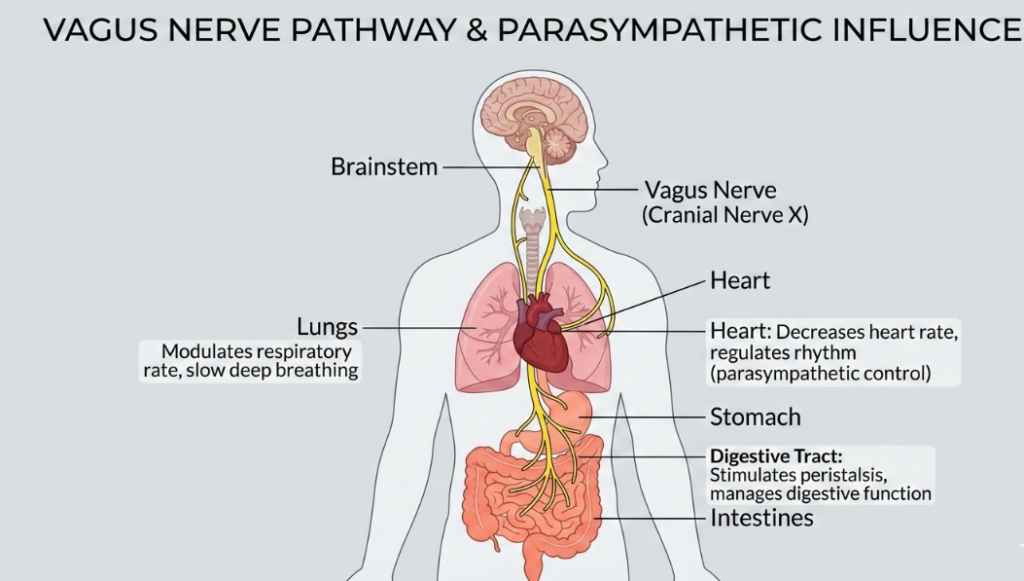
One of the simplest ways to do this during a study session is through “physiological sighs”—two quick inhales through the nose followed by a long, slow exhale through the mouth. This physical act forces your heart rate to slow down almost instantly. When your heart rate drops, the brain receives a biochemical signal that the “predator” (the deadline) is no longer an immediate threat to your life. This clears the fog of academic burnout and allows you to tackle complex problems with a renewed sense of calm.
Strategic Delegation: Why You Can’t Do It All
True neurowellness isn’t just about breathing exercises; it’s about reducing the total number of stressors hitting your brain at once. If you are struggling with a complex set of equations or technical data while trying to maintain your mental peace, it is okay to seek specialized assistance. Many top-performing students utilize Math Assignment Help to bridge the gap in their understanding and keep their projects on track.
4. The 90-Minute Pulse Method
Our brains work in “ultradian rhythms.” This means we can only maintain high-level focus for about 90 minutes before our output begins to drop and our stress levels begin to rise. Instead of “powering through” for six hours—which spikes cortisol and leads to mistakes—work in 90-minute blocks followed by a 20-minute nervous system reset. During these resets, do not check your phone or emails. Instead, look at something in the distance to relax your eye muscles or do a quick somatic stretch.
5. Sensory Health and Workspace Optimization
Your environment is constantly sending “safety” or “threat” data to your nervous system. If your desk is a mountain of old coffee cups and your room is dimly lit, your brain perceives a state of “unresolved chaos.” To optimize for neurowellness, try “sensory grounding.”
- Olfactory: Use scents like lavender or peppermint to anchor your focus.
- Tactile: Use a weighted lap pad or adjust your chair height to ensure your feet are flat on the floor (this signals stability to the brain).
- Auditory: Listen to “brown noise” or binaural beats, which help synchronize the hemispheres of the brain.
6. Cold Water Therapy for Immediate Resets
If you feel a full-blown panic attack or “brain freeze” coming on, use the mammalian dive reflex. Splash ice-cold water on your face or hold an ice cube in your hand. The sudden temperature change forces the nervous system to “reset” and can break the loop of recursive, stressful thoughts. It is like hitting the hard-restart button on a lagging computer.
The Psychology of Procrastination and Emotion Regulation
In 2026, psychologists have largely agreed that procrastination is not a time-management problem; it is an emotion regulation problem. We avoid tasks because they make us feel anxious, bored, or inadequate. When your nervous system is dysregulated, these emotions feel 10x larger than they actually are.
By using the neurowellness techniques mentioned above—like vagal toning and strategic delegation—you remove the emotional “threat” associated with the work. When the task no longer feels like a threat to your biological safety, you can enter a “Flow State.” This is the peak of human performance, where time seems to disappear, and your work becomes an extension of your natural thoughts.
Long-Term Maintenance for Academic Success
Neurowellness is a muscle. The more you practice shifting from “Fight” to “Flow,” the more resilient you become.
Weekly Neurowellness Checklist:
- Digital Detox: At least 2 hours before bed, turn off blue light to protect your melatonin production.
- Somatic Movement: Engage in yoga or walking to “shake off” stored physical tension from sitting at a desk.
- Nature Exposure: Even 10 minutes of looking at trees or sky can significantly lower cortisol levels.
- Resource Mapping: Know who your supporters are. Whether it’s a peer group, a mentor, or a professional service, knowing you have a “safety net” prevents the nervous system from hitting the panic button.
Conclusion: Sustainability Over Speed
The goal of a student or a professional in today’s high-pressure environment isn’t just to finish the work—it’s to finish the work with your mental health intact. Chronic stress shrinks the hippocampus (the memory center of the brain), meaning that “cramming” at the expense of your nervous system actually makes you less intelligent over time.
By treating your nervous system with respect, using somatic tools to stay grounded, and knowing when to delegate heavy academic burdens to experts, you ensure that your success is sustainable. Don’t just work harder; work in alignment with your biology. When your brain feels safe, your best work follows naturally.
Frequently Asked Questions
What is the quickest way to calm down during a stressful deadline?
The most effective immediate reset is the “physiological sigh.” Inhale deeply through your nose, add a second short sniff to fully inflate the lungs, and then exhale slowly through your mouth. This physical action sends an instant signal to your brain to lower your heart rate.
How does chronic stress affect my ability to learn?
When you are constantly in “fight-or-flight” mode, your brain diverts energy away from the prefrontal cortex, which handles logic and memory. Over time, this makes it harder to retain new information and solve complex problems, essentially making your study sessions less effective.
What is the 90-minute rule for productivity?
Human focus operates in ultradian rhythms, which typically last about 90 minutes. After this window, your mental energy and cognitive clarity begin to drop. Taking a 15-minute break away from screens at this point allows your nervous system to recover so you can maintain high-quality output in the next block.
Why is delegation important for mental well-being?
Managing every single task personally leads to decision fatigue and cognitive overload. By strategically offloading specific technical or administrative burdens, you reduce the total “threat” your brain perceives, allowing you to stay in a calm, creative state rather than hitting a state of burnout.
About The Author
Min Seow is a dedicated wellness advocate and lifestyle consultant who focuses on the intersection of mental health and productivity. With a passion for helping others achieve a balanced life, Min explores modern strategies for managing stress in high-pressure environments. Currently a contributor at myassignmenthelp, Min provides insights on how to maintain personal well-being while navigating the demands of contemporary life.